What does it really mean for young people to have a seat at the table where decisions about our future are made?
I began asking this question during my time at the Nairobi Summer School on Climate Justice (NSSCJ).
I had always cared about climate action, but before NSSCJ, I largely understood it through what young people could do within their communities. The Summer School opened another dimension for me. It introduced me to climate governance, climate negotiations, justice, and advocacy, and helped me see how what happens in a community in Kenya connects to decisions made at national, regional, and international levels.
For me, NSSCJ was not simply a learning experience. It changed the way I understood my place in the climate movement.
I began to realise that if young people are going to shape the decisions that affect their future, they need more than opportunities to speak. They need to understand how decisions are made, where they are made, who makes them and, importantly, how they can influence those processes.
I remember making a personal declaration to myself during that period: I did not want to remain only a local climate action champion. I wanted to grow into a global climate leader.
That declaration has shaped much of what I have done since.
Today, I serve as Chairperson of the Kenya Youth Climate Advisory Council, a Steering Committee Member of the Children and Youth Pavilion at the 31st United Nations Climate Change Conference (COP31), and a Care About Climate Nationally Determined Contribution (NDC) Ambassador to Kenya. I also had the privilege of serving as Convenor and National Coordinator of the Local Conference of Youth (LCOY) Kenya 2026.
But when I look at my journey to LCOY Kenya, I do not see it as a standalone achievement. I see it as part of a longer journey that began with learning, grew through participation, and eventually led to leadership.
From participant to coordinator
My relationship with the Local Conference of Youth (LCOY) started from the other side of the table. LCOY is a youth-led initiative under YOUNGO, the official children and youth constituency to the United Nations Framework Convention on Climate Change (UNFCCC). For me, one of the easiest ways to understand its importance is to think of it as a bridge.
In 2025, I participated in the National Local Conference of Youth (LCOY) Kenya in Naivasha as a young person eager to learn, engage and contribute to the climate conversation.
That experience changed how I viewed youth participation. I began to see LCOY not simply as a conference, but as a platform through which young people could organise themselves, articulate their priorities and contribute to shaping the climate agenda.
There is often a gap between young people experiencing the realities of climate change and the spaces where climate policies are designed. Young people may be dealing with drought, floods, unemployment, food insecurity, health challenges or loss of livelihoods, while climate discussions are taking place in policy spaces that can feel far removed from their everyday realities.
LCOY can help bridge that gap by creating space for young people to come together, identify the issues affecting them, develop collective positions and formulate recommendations that can feed into wider climate processes.
When YOUNGO opened the call for applications to host Local Conferences of Youth (LCOYs) in 2026, I decided to apply to host the National LCOY Kenya.
I applied with a consortium comprising the Organization of African Youth Kenya, where I serve as Programs Officer; the Kenya Youth Climate Advisory Council, where I serve as Chairperson; and MuemAction Post.
The application process made us think beyond organising a conference. We had to think about how to create a genuinely inclusive national process, one that could reach young people across different regions and backgrounds and translate their experiences into a collective youth climate agenda.
When YOUNGO accredited us to host LCOY Kenya 2026, I took on the responsibility of serving as Convenor and National Coordinator.
It was an emotional moment for me.
I had told myself years earlier, during the Nairobi Summer School on Climate Justice, that I wanted to become a global climate leader. Now I was in Kenya, entrusted with coordinating a process connected to the global youth climate movement.
But the accreditation was not simply an opportunity. It was also an accountability mechanism. We had to demonstrate that we could convene young people, create an inclusive process, work with partners and different regions, and produce meaningful youth outcomes that could contribute to the wider UNFCCC process.
That responsibility shaped how we approached LCOY Kenya from the beginning.
Beyond the conference room
One thing became clear to me very early in the process: meaningful youth participation cannot begin and end in a conference room.
If the purpose was to develop a collective national youth climate agenda, then the national process had to begin much earlier and reach much further.
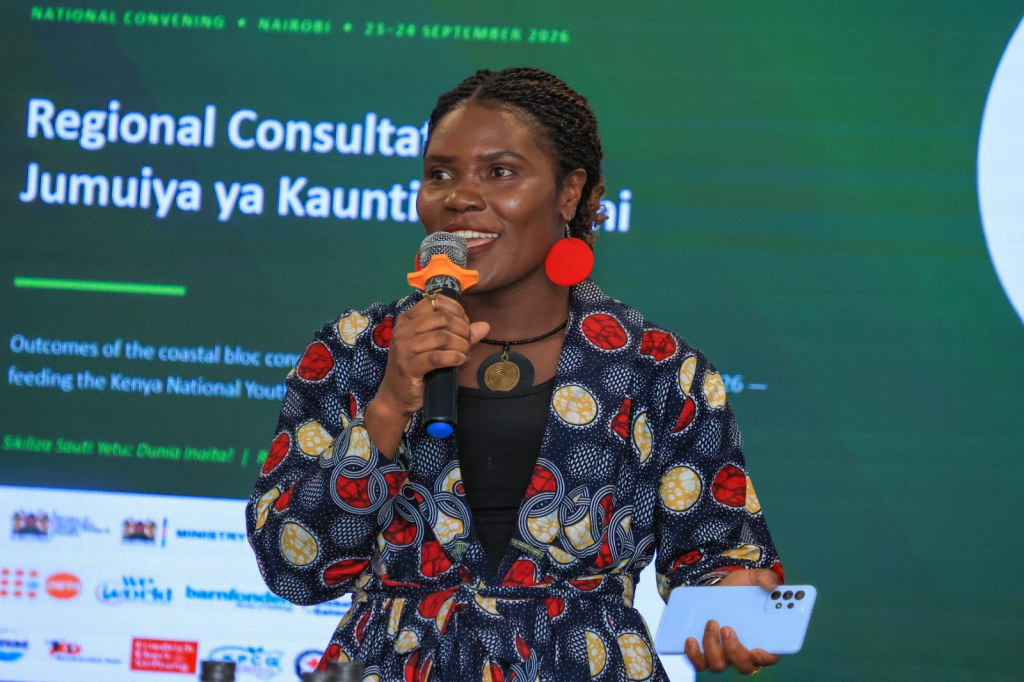
We therefore engaged young people through regional and virtual consultations, including engagements in the Mount Kenya and Aberdare region, Jumuiya ya Kaunti za Pwani and through the Frontier Counties Development Council. We also held virtual consultations that brought together young people from 39 counties.
These conversations mattered because climate change does not look the same everywhere.
The experience of a young person in a frontier county can be very different from that of a young person living with flooding, coastal challenges or other climate-related pressures elsewhere in the country. Yet the regional experience also showed me that many of the underlying challenges are deeply connected.
Young people were talking about climate finance, loss and damage, climate justice, meaningful participation, gender equality, livelihoods, health and the transition to a green economy.
The lesson for me was clear: youth climate advocacy cannot be built around one narrative. We have to make room for different experiences, different regions and different forms of knowledge.
And as those conversations came together, another important message emerged. Young people are not asking for climate action to be treated simply as an environmental issue. They are looking at climate change through the realities of their lives.
When young people talk about a just transition, they are also talking about education, employment, skills and livelihoods.
When they talk about climate finance, they are asking how resources can reach the communities that need them.
When they talk about climate and health, they are recognising that climate impacts are not experienced equally.
And when they talk about peace and security, they are recognising that climate pressures interact with existing vulnerabilities.
These issues are interconnected.
But perhaps the most important question was about participation itself.
Are young people simply being invited into conversations, or are they being given meaningful opportunities to influence decisions?
This is where I think the conversation around youth participation needs to evolve.
A seat at the table matters. But a seat without influence can easily become symbolic.
We need to ask what happens after young people have spoken.
Were their priorities documented? Did they contribute to collective positions? Were those positions taken into policy discussions? Did their participation influence decisions?
Young people do not simply want invitations to consultations. They want their participation to translate into influence, representation and decision-making power.
For me, one of the most powerful moments during LCOY Kenya 2026 was watching young people realise that their own experiences were legitimate contributions to climate policy.
You could see it in the discussions.
A young person who might never have imagined themselves speaking in a national or a global policy conversation was suddenly discussing climate finance. Another was challenging how youth participation is structured. Those moments reminded me why creating these spaces matters.
The Kenya National Youth Climate Statement became one of the major outcomes of the process. For me, the statement represents more than a document. It is a record of what young people collectively said during the process and a tool that can be taken into conversations beyond the conference itself.
Perhaps the most satisfying part was seeing the journey come full circle. We began with regional and virtual consultations. We brought those conversations into the national conference. We consolidated the priorities into a national youth statement. From there, those outcomes can connect with wider regional and global youth climate processes leading towards COP31.
That is what made LCOY Kenya 2026 meaningful for me. It was not just two days in Nairobi. It was a process.
What the journey has taught me
The Nairobi Summer School on Climate Justice gave me the confidence to dream beyond my immediate surroundings. It exposed me to climate governance and helped me understand that community realities are connected to decisions made far beyond the community level.
LCOY then gave me another opportunity: to participate, organise and contribute to a process through which young people could articulate their own priorities.
The journey from NSSCJ to LCOY Kenya has therefore taught me that leadership does not begin when you receive a title.
It begins when you become willing to learn, ask questions, participate and take responsibility. I did not start with everything figured out.
I was simply a young person who cared about climate action and wanted to understand how decisions were being made. So, to other young Kenyans who want to engage in climate policy, I would say: do not wait until you feel ready.
Start where you are.
Learn. Ask questions. Participate. Organise. Build relationships. And when opportunities to influence decisions emerge, step forward. Because young people should not only be seen as the generation that will inherit the consequences of today’s climate decisions.
We must also be recognised as people who can shape the decisions being made today.
And that brings me back to the question that started this journey for me:
What does it really mean for young people to have a seat at the table?
I think I understand it differently now.
It is not enough to be invited.
It is not enough to be heard.
It is not even enough to have our words recorded in a document.
The real measure of participation is whether young people have the knowledge, space, resources and power to influence the decisions that shape their future.
A seat at the table is a beginning.
By Brendah Oluoch- NSSCJ Alumnus