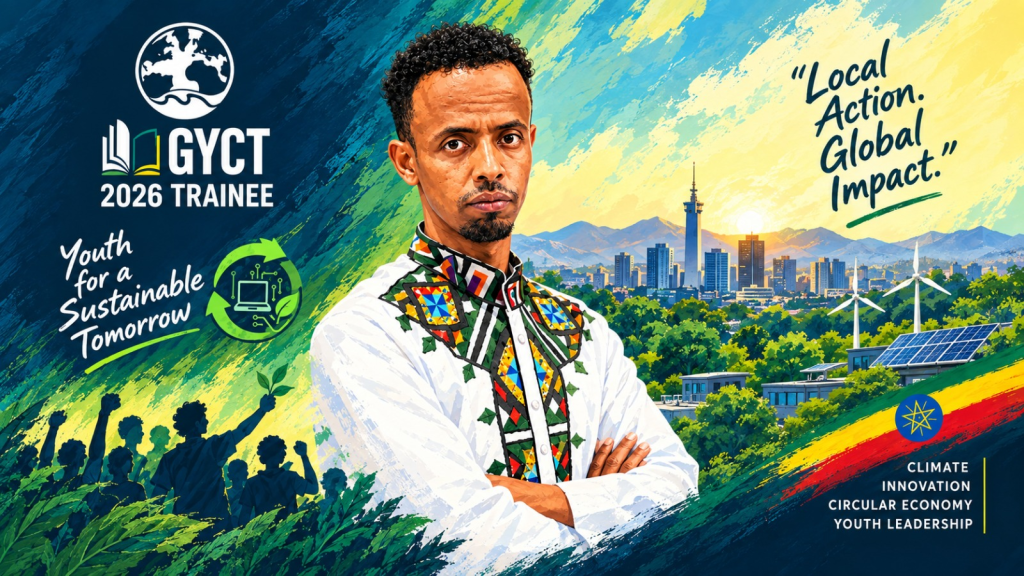
By Zekarias Yemane Berhe
Founder, Green E-Cycle | AI & Climate Innovation Practitioner | Ethiopia
For me, innovation has never been only about technology. It has always started with a question: How can we use the tools available to us to solve problems that matter to our communities?
My journey has taken me from information technology and digital innovation into climate action, circular economy, youth leadership and, increasingly, artificial intelligence. Today, I am exploring how these areas can come together to develop practical and locally relevant solutions to some of the environmental and development challenges facing Ethiopia and Africa.
My foundation began with a B.Sc. in Information Technology (Engineering) from Mekelle Institute of Technology, followed by an MBA in Information System Management. This combination of technology and management has shaped the way I approach innovation. I am interested not only in what technology can do, but also in how solutions can be implemented, managed, communicated and ultimately create value for people and communities.
As climate challenges increasingly intersect with digital transformation, I have continued expanding this foundation through artificial intelligence and climate-focused learning.
One of the clearest expressions of this journey is Green E-Cycle, a youth-led circular economy initiative focused on electronic waste in Ethiopia.
E-waste is not only an environmental challenge. Behind every discarded computer, phone, battery or electronic component are recoverable materials, potential economic value, environmental impacts and opportunities for green jobs.
Green E-Cycle began from the desire to turn this challenge into an opportunity by promoting responsible e-waste management while exploring ways to recover value, create green opportunities and build greater awareness around the circular economy.
As the project evolved, I began asking a different question. What if we could add intelligence to the recycling system?
This led to the development of Green E-Cycle AI, a circular economy and e-waste platform concept exploring how artificial intelligence could support e-waste identification, assessment, recycling engagement and data-driven decision-making.
The concept incorporates AI research and content agents, a digital environmental footprint calculator and bilingual English and Amharic support to make circular economy information and engagement more accessible.
I have also developed an early Green E-Cycle MVP using Amazon PartyRock, combining a live web presence with an AI layer to demonstrate how users could interact with digital recycling, device assessment and environmental engagement features.
The longer-term vision is to develop an intelligence layer for the circular economy, connecting digital information, collection systems, material recovery and real-world environmental action.
My interest in AI has since expanded beyond e-waste into other climate and development challenges. UrbanSentinel AI is a climate-hazard early-warning concept designed to explore how AI and environmental data can help identify potential risks and provide timely alerts to communities, supporting anticipatory action and climate resilience.
Another concept, ዓደይ Harvest, is an AI-powered localized climate advisory tool for Ethiopian smallholder farmers, providing tailored, region-specific guidance to support better agricultural decision-making and climate resilience. The prototype was developed using Anthropic’s generative AI technology.
These projects are at different stages of development, but they share a common direction in my work. I am interested in using AI not simply because it is new, but because it can potentially make climate and development solutions more accessible, localized and intelligent.
This interest connects naturally with my current engagement in the IGAD Regional Youth Coalition on Climate-Resilient Agri-Food Systems, a growing network of young leaders working to advance climate action and resilient agri-food systems across the region.
Through this regional youth community, I am currently involved in work connected to youth harnessing technology for early action and early warning. This is particularly meaningful to me because it brings together several areas that are increasingly shaping my work, including technology, climate resilience, agriculture, early warning and youth leadership.
It reinforces a principle I increasingly believe in. Information becomes most valuable when it enables people to act before a crisis escalates.
For me, this creates a bridge between AI innovation and practical climate resilience. The goal is to develop and support technologies that can help communities anticipate risks, make informed decisions and act earlier.
My journey has also been shaped by experiences that go beyond technology. My engagement with the Nairobi Summer School on Climate Justice (NSSCJ), organised through the Pan-African Climate Justice Alliance (PACJA), gave me an important space to learn, connect, participate and understand climate action from a broader perspective.
One particularly valuable part of this experience was engaging in the Climate Security sub-track within NSSCJ. The track explored the impacts of the climate crisis on peace and security, particularly in fragile and conflict-affected settings.
This broadened my understanding of climate action beyond environmental solutions alone. It helped me see how climate risks can intersect with livelihoods, food systems, displacement, social stability, conflict and security.
It also changed the way I think about technology.
Climate technology is not only about reducing emissions or monitoring environmental conditions. It can also contribute to early warning, preparedness, resilience, informed decision-making and preventing risks from escalating.
This perspective connects closely with my interest in UrbanSentinel AI and with my current engagement in regional early-action and early-warning work. NSSCJ therefore became more than a learning experience for me. It helped connect technology with the wider human, social and geopolitical dimensions of climate change.
My journey has also taught me that innovation requires more than technical skills. It requires the ability to bring people together, listen to different perspectives, build partnerships and turn ideas into collective action.
My earlier experiences in leadership development, including the Safe Light Leadership Academy, helped strengthen my confidence, communication and understanding of leadership. Today, that foundation is increasingly being translated into practical work.
As Lead Organizer of LCOY Ethiopia 2026, I am involved in a youth-led national climate engagement process designed to create meaningful space for young Ethiopians to articulate their priorities, connect around solutions and contribute to wider climate decision-making.
For me, this represents an important form of leadership. It is not about speaking on behalf of young people, but helping create the space and process through which young people can articulate their own priorities and contribute to the conversations shaping their future.
This complements my work through Green E-Cycle, where leadership means turning an environmental challenge into an opportunity for innovation and entrepreneurship, and my engagement with the IGAD Regional Youth Coalition, where young people are contributing to regional climate resilience efforts.
Across these different spaces, the thread remains clear. Leadership development has gradually evolved into practical sustainability action, youth climate leadership and national and regional engagement.
I increasingly see leadership not as a title, but as the ability to create pathways for people, ideas and solutions to move forward.
My experiences have also reinforced another important lesson. Africa should not only be a consumer of emerging technologies. We should also become builders, experimenters, researchers and problem-solvers.
For me, this means asking how AI and digital technologies can work within our realities, including multilingual communities, limited infrastructure, climate vulnerability, informal economies, agricultural livelihoods and rapidly growing environmental challenges.
It also means being careful not to treat AI as a solution by itself.
Technology needs context. It needs human participation, responsible design, local knowledge and a clear understanding of the problem it is intended to solve.
This is why I am particularly interested in the intersection of AI, circular economy, climate resilience, sustainable agriculture, early warning and youth-led innovation.
I am continuing to strengthen my technical and applied AI capabilities through FUSE AI-101, Foundations of Artificial Intelligence, and FUSE AI-201, AI Model Development and Implementation.
I have also engaged with the Climate Change AI Summer School, including the Climate Security track through NSSCJ, which helped me explore the relationship between climate risks, technology, peace and security.
Together, these experiences are helping me connect three areas that increasingly shape my work: technology and AI, climate resilience, and people and communities.
My vision is to continue developing solutions that connect technology with real-world environmental and climate action.
For Green E-Cycle, that means moving from awareness and recycling activities towards smarter systems for e-waste collection, assessment, recovery and circular economy intelligence.
Through my wider innovation work, I want to continue exploring how AI and digital technologies can contribute to early warning, climate resilience, sustainable agriculture, circular economy and inclusive innovation across Ethiopia and the wider African region.
My journey is still evolving. Some of these ideas are prototypes, some are concepts and others are becoming practical experiments. I see that as part of the innovation journey itself, testing, learning, adapting and improving.
But they all come from the same belief. Innovation becomes meaningful when technology is connected to a problem people genuinely need to solve.
I am grateful to the people, communities, programmes and networks that have contributed to my journey, including NSSCJ-PACJA, the youth climate action community and the regional networks that continue to create opportunities for young people to learn and lead.
The next chapter is about taking what I have learned from technology, climate action, AI and youth leadership and turning it into solutions that can create impact beyond myself.
The goal is not simply to build with AI. The goal is to build with purpose.
About the Author
Zekarias Yemane Berhe is an Ethiopian technology professional, entrepreneur and climate innovation practitioner. He is the founder of Green E-Cycle, a youth-led circular economy initiative working on e-waste, green innovation and AI-enabled environmental solutions. His work sits at the intersection of artificial intelligence, circular economy, climate action, youth leadership and sustainable development.