In Ziguinchor, Senegal, the Conseil Régional de la Jeunesse de Ziguinchor (CRJ) and the Association Club Changement du Sénégal à Ziguinchor (A3CS) are working with young people and communities across the three regions of Casamance to respond to climate and environmental challenges.
At the centre of this work is Mamadou Talibé DIALLO, President of CRJ Ziguinchor and President of Team Management at A3CS. He is also an alumnus of Cohort II of the Nairobi Summer School on Climate Justice (NSSCJ), a Pan African Climate Justice Alliance.
“When I joined the Cohort II of the Nairobi Summer School, my main objective was to translate the global concepts of climate justice into concrete community action in Senegal, particularly in Casamance,” Mamadou says.
The need for action was already clear in the communities where he worked. Coastal erosion was threatening parts of Diembéring, while degraded mangroves were contributing to the salinisation of rice fields.
The fisheries sector was also under pressure. According to Mamadou, fishers were seeing their catches decline, but there was limited reliable data to help communities understand and respond to the problem.
“We saw populations becoming powerless in the face of disappearing beaches and bolongs,” he says. “The fishermen were seeing their catches decrease without the tools to measure the crisis scientifically.”
Young people faced their own challenges, including limited employment opportunities, exclusion from local decision-making and a lack of practical training.
Mamadou joined NSSCJ looking for tools that could help change this situation.
The training strengthened his understanding of climate justice, ecological debt and international climate negotiations. It also developed his skills in advocacy, communication, transformational leadership and mediation.
But beyond knowledge, the experience changed how he approached his work.
“The programme deeply transformed my vision by teaching me to move from a purely conservationist approach, planting trees, to an approach based on climate justice and human rights,” he says.
Before the training, reforestation and mangrove restoration were mainly seen as environmental activities.
“Today, when we work with communities, we no longer impose solutions,” Mamadou says. “We co-create projects with them, placing their rights, food sovereignty and local knowledge at the centre of the action.”
That approach now runs through the work of CRJ Ziguinchor and A3CS.
Their activities include the African Youth Camp for Reforestation, Environmental Education and Climate Justice in Diembéring, mangrove restoration and conservation camps, climate bootcamps, transformational leadership training, peace and mediation training, and citizen-led fisheries data collection.
The work puts young people at the centre.
“They are not simply passive beneficiaries of our projects,” Mamadou says. “They are the designers, facilitators and main drivers on the ground.”
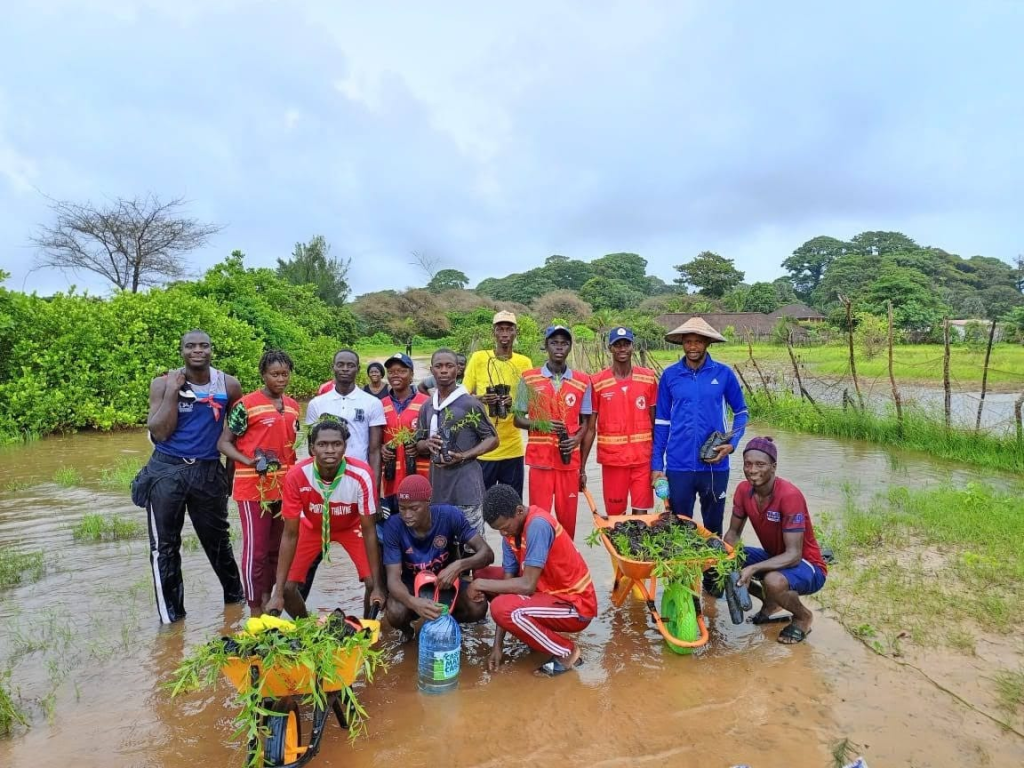
At the coastal reforestation camps in Diembéring, young people take practical action against erosion while learning about environmental protection and climate justice.
One particular moment remains with Mamadou.
More than 100 young people from different localities gathered at dawn to work alongside village elders.
“Seeing more than a hundred young people get up at dawn, with shovels in their hands, to fix the dunes and fight coastal erosion alongside the village elders was a powerful turning point,” he recalls.
For him, it was a moment when what he had learned in Nairobi became visible on the ground.
“What marked me deeply was seeing the theory of climate justice learned in Nairobi materialise before my eyes,” he says.
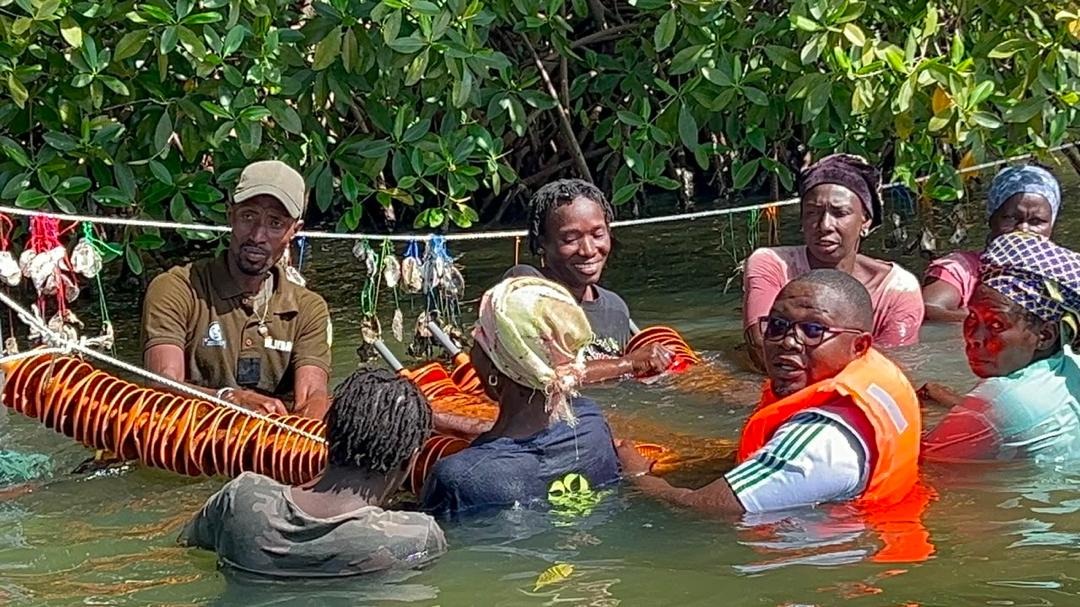
The work has also extended into the mangroves.
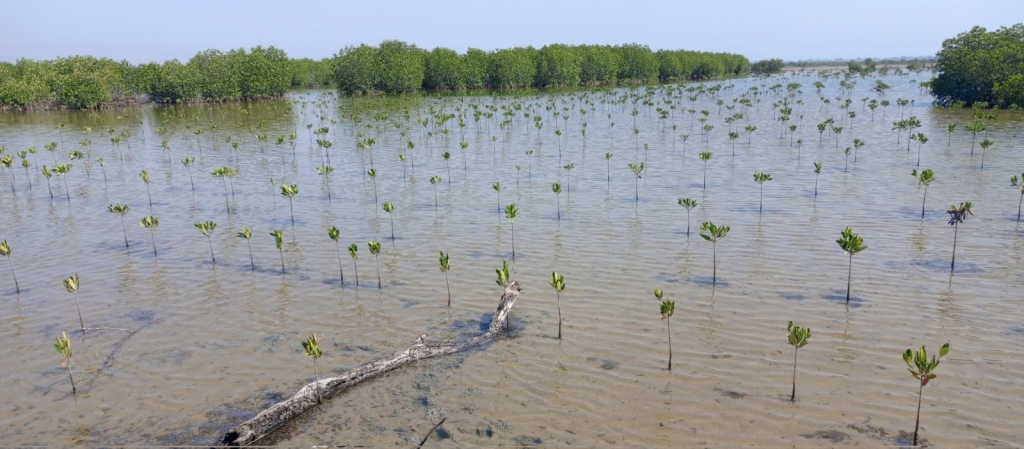
Young people participate in restoration activities aimed at regenerating degraded ecosystems, protecting rice fields from salinisation and supporting fish breeding areas.
They are also collecting data on artisanal fisheries.
At fish landing sites, trained young people work with fishers to document catches and information on local fish stocks.
Women are part of this process too.
In Casamance, women involved in oyster harvesting and fish processing bring their knowledge of the mangrove ecosystem into restoration and fisheries activities.
Community elders and traditional leaders are also involved in planning activities.
The approach has helped bring different generations into the conversation.
So far, Mamadou estimates that more than 300 young people have participated in climate bootcamps, transformational leadership training and peace and mediation activities.
The work has reached more than 10 communities and villages in Lower Casamance, with about 150 artisanal fishers and women fish processors directly engaged through awareness and fisheries data collection activities.
For Mamadou, the most visible change is among the young people themselves.
“The most significant change among the young people involved is their transition from spectators to key actors in local development,” he says.
Young people are now involved in planning, budgeting, logistics, co